I didn’t write this. I just like it.

I received this from a very good friend.  He’s not a military guy.  He’s not a Republican. He’s not from a fly-over state.   He’s definitely not a Fundamental Christian.  But we can all can get behind the sentiment expressed in this email.
I’ve taken some small liberties with the formating. Everything below the line is what I received.
———————————————————————————————————
To: {everyone I know}
Subject: AN AIRLINE CAPTAIN’S REPORT . . . A must read!


“The American flag does not fly because the wind moves past it . . .
The American flag flies from the last breath of each military member who has
died serving it.”

AIRLINE CAPTAIN — You will not regret reading this one.

My lead flight attendant came to me and said, “We have an H.R. on this flight.” (H.R stands for Human Remains.)

“Are they military?” I asked.

‘Yes’, she said.

‘Is there an escort?’ I asked.

‘Yes, I’ve already assigned him a seat’.

‘Would you please tell him to come to the Flight Deck. You can board him early,” I said.

A short while later a young army sergeant entered the flight deck.  He was the image of the perfectly dressed soldier.  He introduced himself and I
asked him about his soldier.

The escorts of these fallen soldiers talk about them as if they are still alive and still with us.  ‘My soldier is on his way back to Virginia,’ he said.  He proceeded to answer my questions, but offered no words.

I asked him if there was anything I could do for him and he said no.  I told him that he had the toughest job in the military, and that appreciated the work that he does for the families of our fallen soldiers.  The first officer and I got up out of our seats to shake his hand.  He left the Flight
Deck to find his seat.

We completed our preflight checks, pushed back and performed an uneventful
departure.  About 30 minutes into our flight, I received a call from the lead flight attendant in the cabin.

‘I just found out the family of the soldier we are carrying, is also on board’, she said.  She then proceeded to tell me that the father, mother, wife and 2-year old daughter were escorting their son, husband, and father
home.  The family was upset because they were unable to see the container that the soldier was in before we left.

We were on our way to a major hub at which the family was going to wait four hours for the connecting flight home to Virginia.  The father of the soldier told the flight attendant that knowing his son was below him in the cargo compartment and being unable to see him was too much for him and the family
to bear.  He had asked the flight attendant if there was anything that could be done to allow them to see him upon our arrival.  The family wanted to be outside by the cargo door to watch the soldier being taken off the airplane.

I could hear the desperation in the flight attendants voice when she asked me if there was anything I could do. ‘I’m on it’, I said.  I told her that I would get back to her.

Airborne communication with my company normally occurs in the form of e-mail like messages.  I decided to bypass this system and contact my flight dispatcher directly on a secondary radio.  There is a radio operator in the
operations control center who connects you to the telephone of the dispatcher. I was in direct contact with the dispatcher.  I explained the situation I had on board with the family and what it was the family wanted. He said he understood and that he would get back to me.

Two hours went by and I had not heard from the dispatcher.  We were going to get busy soon and I needed to know what to tell the family.  I sent a text message asking for an update.  I saved the return message from the
dispatcher and the following is the text:

‘Captain, sorry it has taken so long to get back to you.  There is policy on this now, and I had to check on a few things.  Upon your arrival a dedicated escort team will meet the aircraft.  The team will escort the family to the
ramp and plane side.  A van will be used to load the remains with a secondary van for the family.

The family will be taken to their departure area and escorted into the terminal, where the remains can be seen on the ramp.  It is a private area for the family only.  When the connecting aircraft arrives, the family will be escorted onto the ramp and plane side to watch the remains being loaded for the final leg home.

Captain, most of us here in flight control are veterans.  Please pass our condolences on to the family.  Thanks.

I sent a message back, telling flight control thanks for a good job.  I printed out the message and gave it to the lead flight attendant to pass on to the father.  The lead flight attendant was very thankful and told me,
‘You have no idea how much this will mean to them.’

Things started getting busy for the descent, approach and after landing. we cleared the runway and taxied to the ramp area.  The ramp is huge with 15 gates on either side of the alleyway.  It is always a busy area with aircraft maneuvering every which way to enter and exit.  When we
entered the ramp and checked in with the ramp controller, we were told that all traffic was being held for us.

‘There is a team in place to meet the aircraft’, we were told.  It looked like it was all coming together, then I realized that once we turned the seat belt sign off, everyone would stand up at once and delay the family from getting off the airplane.  As we approached our gate, I asked the
copilot to tell the ramp controller, we were going to stop short of the gate to make an announcement to the passengers.  He did that and the ramp controller said, ‘Take your time.’

I stopped the aircraft and set the parking brake.  I pushed the public address button and said:  ‘Ladies and gentleman, this is your Captain speaking: I have stopped short of our gate to make a special announcement.
We have a passenger on board who deserves our honor and respect.  His name
is Private XXXXXX, a soldier who recently lost his life.  Private XXXXXX is under your feet in the cargo hold.  Escorting him today is Army Sergeant XXXXXX.  Also, on board are his father, mother, wife, and daughter.  Your entire flight crew is asking for all passengers to remain in their seats to allow the family to exit the aircraft first.  Thank you.’

We continued the turn to the gate, came to a stop and started our shutdown procedures.  A couple of minutes later I opened the cockpit door.  I found
the two forward flight attendants crying, something you just do not see.  I was told that after we came to a stop, every passenger on the aircraft stayed in their seats, waiting for the family to exit the aircraft.

When the family got up and gathered their things, a passenger slowly started
to clap his hands.  Moments later, more passengers joined in and soon the entire aircraft was clapping.  Words of ‘God Bless You’, I’m sorry, thank you, be proud, and other kind words were uttered to the family as they made their way down the aisle and out of the airplane.  They were escorted down
to the ramp to finally be with their loved one.

Many of the passengers disembarking thanked me for the announcement I had made.  They were just words, I told them, I could say them over and over again, but nothing I say will bring back that brave soldier.

I respectfully ask that all of you reflect on this event and the sacrifices that millions of our men and women have made to ensure our freedom and
safety in these United States of AMERICA.

Foot note:

I know everyone who reads this will have tears in their eyes, including me. Prayer chain for our Military.. Don’t break it!  Please send this on after a
short prayer for our service men and women.

Don’t break it!

They die for me and mine and you and yours and deserve our honor and respect.

Prayer Request:  When you receive this, please stop for a moment and say a prayer for our troops around the world.. There is nothing attached.  Just send this to people in your address book.  Do not let it stop with you.  Of all the gifts you could give a Marine, Soldier, Sailor, Airman, and others  deployed in harm’s way, prayer is the very best one.

GOD BLESS YOU!!!

Thank you all who have served, or are serving.

We will not forget!!!
 

Connectivity

Years ago, in the pre-mobile phone era, or even in the roaming-is-so-expensive-you-don’t-dare era, I used to do a lot of business travel.  And Sally and I used to take vacations.  For each of these, I would prepare a list of travel information and contacts for those left behind – Sally if I was on business, our kids or their babysitters if we were on vacation without them.  This would include flights, hotels and phone numbers, contacts at my offices if I was on business and their contacts, etc.  This would enable someone to get in touch with me / us in the event of an emergency.

20170716 Where are we? 20170716 Where are we? Where are-2

Where are we?, July 2017

With the dawn of mobile communications, global email and texting, this became a much less intensive and critical exercise.  Now when we travel for pleasure, we usually let the kids know what our flights are, and generally where we’ll be.  And of course, since I’ve been blogging our major trips, all of you are kept up to date with our location as we go along.

This all changes for Africa.  For one thing, we probably won’t have cell service most of the time.   When we’ve traveled to Europe recently, we were able to (one way or another) tap into the local cell networks either with a wifi hot spot or directly with our mobile phones, as AT&T (and Verizon) have made roaming affordable.  Neither one has any local partners in South Africa or Botswana that I can see.  We will have wifi in our city hotels, so we’ll be able to communicate when we are there.  But while out and about, we’ll be mostly non-communicating.

I will look into getting a local SIM card for my allegedly unlocked iPhone while we’re in Johannesberg and Capetown, but I’m skeptical that it will work.

In addition to the cities (Johannesberg, Cape Town and Victoria Falls) we’ll be in four different camps on this trip.  Two of them have no Internet connectivity whatsoever.  So for the first time in many years, we will be completely off the grid.  If I remember correctly, the most recent time we were even close to this was in Anguila about 12 years ago. There was no cell service, no wifi, and no phone in our room.  There was a phone near the front desk that you could use, and I recall having to make some business-related calls while we were there.

In addition to the two camps that are explicit about having no wifi, I’m expecting wifi to be limited at the other two camps.  While texts and emails might get through, I’m doubtful that I’ll be able to upload any pictures.  And we have been in many city hotels where the wifi was barely useful in recent years.  But maybe I’ll be pleasantly surprised.

In any event, I have created a two page schedule of our flights and accomodations which I’ll leave with our kids before we go.  Not that I expect them to need it.  Unlike years past, this list doesn’t have phone numbers or addresses for our accomodations, nor the scheduled times for our flights.  Rather, I just give the web link for each and expect anyone who wants to get more information – and up-to-date information – will just hit the link.

Photographic gear for safari

Tuesday, July 11, T-15

Our upcoming trip to Africa was a birthday present to Sally from me: pick any place in the world you want to go, including a place that I’ve resisted in the past, and we will go there.   And I promise not to whine or complain.  After a bit of thought, she settled on an African Safari.   And I began planning for the photography gear I’d need to shoot (1) wild animals in the bush.

Here’s the thing about wild animal photography: the animals usually don’t cooperate.  They’re often far away, they move around unexpectedly, they hide in grass and brush, and they’re most active when the light is dim (dawn and dusk).  This drives you to want to have big heavy cameras that shoot fast and work well in low light, and big heavy lenses that have high magnification and work well in low light.  Every equipment decision therefore becomes a balancing act between how much weight you can bring and how much flexibility you want in the field.  Add to that the special requirements for an African safari: you travel on small airplanes with severe weight restrictions, you have limited (i.e. no) ability to repair or replace equipment that fails, and the dusty conditions mean you don’t want to be switching lenses while out and about.

I’ve never even owned the biggest and baddest cameras or lenses.   The most demanding thing I usually shoot from an equipment perspective is kids’ sports and shows.  I used to use medium sized equipment from Nikon (so-called “crop sensor”), but switched a few years ago to a class of camera called “micro 43” or m43, which uses a smaller sensor and therefore smaller lenses.  This enables one to save a lot of weight and space.   I estimate that my m43 kit, for similar capabilities, is about half the weight of my old Nikon kit.  And given the progress in digital camera technology, my current gear out-performs my old Nikon gear in most ways.   And the old stuff performed better than the photographer working the controls and was never the constraint on the quality of my images.

20170711 Camera Kits SGA10002

Cruise cameras and lenses: 4.25 lbs., May 2017

For our trip to Europe this year, I took four lenses that weighed about 2.5 lbs. and encompassed an 11x zoom range from pretty wide (9mm) to moderately long (100mm) (2).  That maximum magnification is woefully inadequate for safari.   Serious wildlife photographers like a magnification ratio at least 2 or 3 times greater, or 300mm.  And sadly, the weight of a lens grows faster than the focal length.   So where the 35-100mm zoom I took to Europe weighs 12 oz., the 40-150mm zoom I’m taking to Africa weighs 31 oz.   And the 100-400mm zoom I’m taking weighs 35 oz (3).

I mentioned that replace or repair is also not an option, so one needs to think about what you would do if some piece of equipment fails.  This stuff is pretty reliable, but it does fail.   I had an old lens actually fall apart in my hand last winter.   I also had the shutter on one of my cameras fail last winter.  The camera has been repaired, while the lens was not repairable.  So I have a strategy for what I would do if any piece of gear I’m bringing fails while we’re in the bush.

20170711 Camera Kits _1390085

Safari cameras and lenses: 8.2 lbs, July 2017

I’m taking four zoom lenses which have some overlap in range: 9-18, 12-35, 40-150 (convertible to 56-210), and 100-400. I’ll also take a fixed 25mm lens.  So:

– if the 9-18 fails, I use the 12-35 and loose the 9-11 range

– if the 12-35 fails, I use the 9-18 anf the 25mm, and loose the 19-24 and 26-35 ranges

– if the 40-150 fails, I use the 100-400 and loose the 40-99 range

– if the 100-400 fails, I put the adaptor on the 40-150 so I can have 56-210, and loose everything over 210.

In the cities, loosing the 12-35 would be the worst case, as I typically take about 2/3 of my “keeper” pictures with that lens.  On safari, loosing either of the long lenses would be a problem.  In any case, the solution would be to use the next shorter lens and crop the resulting pictures as needed.  Or to take different pictures more suitable to the lenses I have.  But hopefully, I won’t have any problems.

The camera backup is simpler: I’m taking two similar cameras, an Olympus OM-D E-M1 and an OM-D E-M1 Mark 2 (3).  Assuming both are working, I’ll use them both with different magnification lenses on each one while we’re driving around in the bush looking for animals, which solves another problem: changing lenses while driving is risky because it’s extremely dusty, and you don’t want to let dust get into the camera or lens.  But if one fails, I’ll have the other.

But other critical gear needs backup as well.  Cameras without batteries are paperweights, and one might use more than one battery in a day. So I will take four batteries for each camera (of course, they use different batteries).  And two chargers for each camera, as they could fail as well.

Finally, I need to plan for how to backup the most important thing, namely all the pictures I shoot (5).  They’re stored on little chips called SD cards, which are pretty reliable, but can fail.  Many serious photographers carry a laptop with them and copy the images into it each day as they travel, and review the images as they go.  I don’t own a laptop, and don’t want to deal with the weight of one, and don’t want to spend my valuable time on the trip reviewing thousands of pictures.  So I have a special device that will simply copy the contents of an SD card onto its own storage, and weighs only 12 oz. It also replaces the USB battery pack I usually travel with, so the net weight increase is only a few ounces.  And as with the other gear, I won’t be able to buy more SD cards in the bush if I fill them up.

And remember, the fact that the kit itself is so much larger and heavier means that the bag is much larger and heavier.  After counting all the stuff I need to bring – what’s listed above, batteries, chargers, tripod, etc. – the safari kit totals about 24 lbs. while the cruise kit was only about 7 lbs. (6)  I can only hope the pictures are 3.4 times as interesting …

—————-

(1) “Shoot” is the easiest term to use when you’re talking about making a photographic image of something.  Unfortunately, it’s also what you do with a gun.  Rest assured that we will not be using any guns on this trip – the only shooting that takes place will be with a camera.

(2) Focal lengths determine magnification, but differently for different classes of cameras.  Compared to old-school 35mm film cameras, an m43 camera requires half the length for equivalent magnification.  So my 35-100mm zoom on an m43 would need to be 70-200mm long on a film or “full frame” digital camera.   For comparison, most phone cameras are equivalent to about 15mm on my m43 cameras, but are actually 2.65mm on the iPhone 6S.

(3) The 100-400mm only weighs a bit more that the 40-150mm because is is the same physical diameter, and therefore works less well in low light situations.  A 400mm lens that had the same light-gathering capability as my 40-150 would probably weigh over 8 lbs.; Nikon’s version, which doesn’t even zoom, weighs 8.4 lbs. and costs $11,000.

(4) I don’t make up these names, I only report them.  The Mark 2 camera is a new improved version of the other.

(5) My professional career in IT started as a database administrator, which instilled in me a lifelong need to make backups of anything digital.  Of course, back in the film days, no one worried about backup – just how many rolls of film they could carry, and how to get them through airport security without being x-rayed. I’m carrying the equivalent of more than 400 rolls of film, not counting the backup copies.

(6) 7 lbs. for just the core kit – it totaled somewhat more than that.

Okay, I’ve been remiss

Monday, July 10, T-16

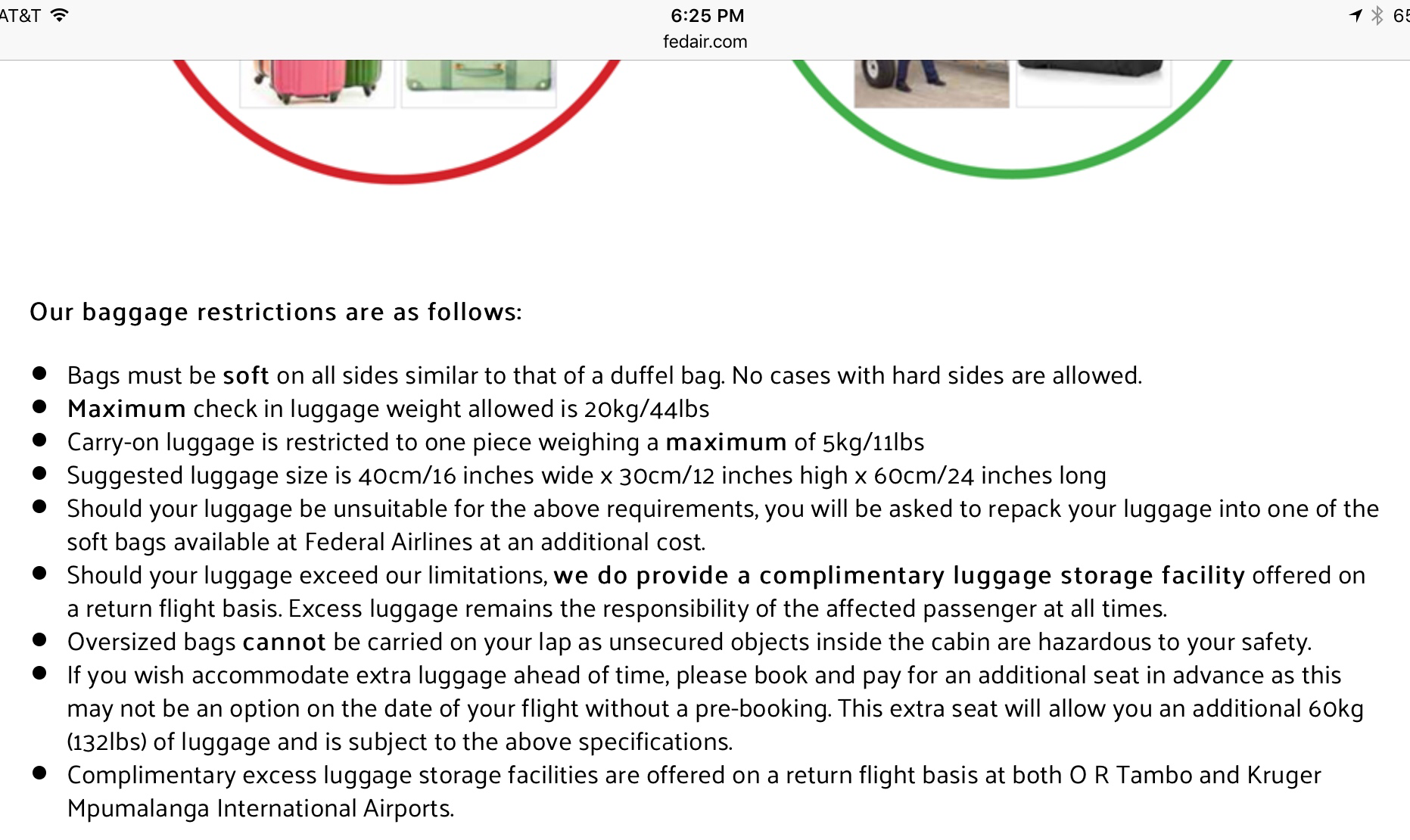
Sally pointed out this evening that I’ve haven’t been keeping you all up to date on my/our planning and packing adventures for our upcoming trip to Africa.  To recap the ground rules, which represent the most restrictive policies of the three scheduled and several charter airlines we are traveling with:

1. We are allowed a total of 44 lbs. of luggage for both cabin luggage and checked luggage.

2. Our luggage must be softsided and without wheels.  Maximum size is 24″ x 16″ x 12″ (Federal Airways).

3. We are allowed a single piece of cabin luggage not to exceed 8kg or 17.6 lbs., plus “1 small handbag or small laptop” (South African Airways), or a single piece up to 5kg or 11 lbs. (Federal Airways).

FedAir Baggage Policy, July 2017

4. We can carry no more than four spare lithium batteries in cabin baggage (British Airways), and (of course) cannot pack any in checked luggage.

5. The unscheduled charters are apparently both more and less flexible.  They do insist on soft luggage with no wheels, but apparently will accept whatever they can shove into the luggage compartment of the plane.

These restrictions pose a challenge to many travelers, but especially those carrying a fair amount of sensitive electronic equipment.  Like my camera kit.

Let’s start with the overall weight restrictions.  On our last trip, the cruise with Matteo and Zelda, my checked bag checked in at 38 lbs.  I had a carry-on backpack with my camera gear and other essentials, like meds, iPad/iPhone, etc. that weighed about 15 lbs.  for that trip, as the camera kit was very modest – some lenses, a backup (and small) backup body, and a bunch of batteries.  No tripod.  I did have a suit and dress shoes, etc.   So about 9 lbs. overweight (38 + 15 = 53 vs. 44) in total when compared to the safari, and also 4 lbs. over for the carry-on.

This Africa trip will require clothing for two environments: we’ll be in the city for eight days, and in camps/lodges in the bush for nine days.   The city clothing is normal sightseeing stuff: very casual during the day for sightseeing, and some nicer casual stuff for dinners in the evening.   The bush clothing is basically hiking clothes: neutral or earthtones so as to not scare the animals (1), warm layers as it’s winter in Southern Africa, hats to block the sun, sturdy hiking shoes or boots, etc.  Unlike the cruise, no need for a suit and tie, fancy dresses, high heels, etc.   We will have complimentary laundry during our time in the camps, but also need to deal with four days in a hotel in Cape Town.  So it’s a balancing act: bring enough stuff to last the one long city stay, or stuff that can be hand-washed in the room (2).

Then there’s the big elephant in the room, so to speak: my camera gear.  The kit for the cruise totaled 12 lbs., and more than 3 lbs. went in my checked bag.  But that trip, while interesting photographically, was not focused on photography, was with three other non-photographers, and was mostly to places I’d been recently.  So I knew in advance that the photography I did would be opportunistic and not involve a lot of setup for any shot.   In particular, no tripod and a minimal set of lenses.  Some days I didn’t even bring a camera bag out, just a camera, an extra lens, and an extra battery.

For this trip, the current estimate for the camera kit is 24 lbs. – a full 12 lbs. more than last time.  I’ll talk some more about this in a future post.  But this leaves me needing to find 23 lbs. to take out of the other stuff I brought on the cruise.  I already have the suit and it’s accessories, which is about 5 lbs.  The other big save is the checked bag itself.   As we’re required to use a soft bag for our checked luggage on this trip, we don’t need our lightweight Tumi rolling luggage at 12.5 lbs.  instead, we’ll each be using a duffle bag supplied by our travel agent which weighs about 2.2 lbs.  Those two alone save me 15 lbs.

Duffle and camera bag, July 2017

The usual way that travel experts say to save weight is to bring easy to wash clothing, and wash it each night.  For the items that I’m bringing multiples ofs (socks, underwear, t-shirts, etc.) I already do this.   It’s been years since I’ve traveled with more than about four days worth of clothing; instead, I drive Sally crazy by always leaving wet clothes hanging around our room (3).  This strategy is constrained by two factors:

– travel days, when your wet laundry may not have time to dry (I’ve never liked to pack wet clothes, plus they just weigh more wet and I already have a weight problem)

– the need for different stuff for different situations.

– The inability to obtain new stuff for most of the trip.

On this trip, we’re in cosmopolitan cities and the bush; we’re in warm weather (high of 82F and bright sun) and cold (low 40s pre-dawn while on a game drive in an open vehicle).  So we need everything from t-shirts to long underwear, insulated jackets, gloves and warm hats.

We’re also in safari camps/lodges for as much as 6 consecutive days, followed by two days in the small town of Victoria, Zimbabwe.  We really can’t count on being able to buy anything that we might have forgotten, lost or broken.  This includes, of course, meds and toiletries.  Given this, we’re both carrying at least a four weeks supply of all of these critical consumables.  While this may not sound like much, my daily meds in the weekly cases add up to about a pound for four weeks.

Anyway, I’ve gotten my non-photography/electronics gear including the duffle bag down to about 18 lbs. or so.  With the camera kit at around 24 lbs., I’m currently just two pounds under my limit assuming I haven’t forgotten anything, and I’m sure I’ve forgotten something(s).

————–

(1) One is universally advised to wear khaki-colored or other neutral colors while on game drives.   Yet I’ve been given to understand that many of the animals, including lions, are colorblind.  But maybe some can see colors.   In any event, we both have appropriately bland stuff.

(2) One could also pay for hotel laundry, but you’d spend less money discarding the soiled items and buying new ones.  I’m not particularly adverse to hand-washing myself, but Sally is less fond of it.

(3) It was no issue when I traveled alone for business, of course; then I didn’t care if I had wet stuff all over, and I was rarely in my hotel and awake.