Warning: there are some disturbing images in this post. So I won’t mind if you skip this one.
We had no scheduled events for our last day in Porto. So we slept a little later than usual (1) and had a later and more leisurely breakfast than usual.
The two days we had spent in Porto didn’t really give us a look at much of the city itself. The first day, the food tasting tour, really never went more than a few blocks from our hotel and was centered around a main pedestrian shopping street, Rue de Santa Caterina. And we had walked the length of that street a couple of times. Yesterday, we spent all day in the Douro Valley. So we wanted to get a look at some other areas. Our information packet for the trip included a suggested list of things to do in Porto that were not on either of the prior days itineraries. So we took off by taxi and foot to see what we could find.

The first recommendation on the list was a park not too far from the river. So we had the hotel call for a taxi and waited. And waited. And had the hotel call again. And then he came and took us to a small park with a nice river view. It turns out this was the wrong park. And it also turns out that the driver overcharged us (2). So we walked the several blocks uphill to the desired park, only to find most of it fenced off. So I count the entire park thing a bit of a bust. But I did get a nice picture of the town overlooking the river from the first park..

We saw that there was a photographic museum near the second park, so we went looking for what I assumed would be a small building, perhaps in a side street. I had the address, and Google gave us somewhat unclear directions where to go. It turns out that the museum is in an abandoned prison, which was a huge building right in front of us on a large plaza. Impossible to miss if you know what to look for.

The museum has two main exhibits. On the third floor is a camera exhibit. I never bothered to go see that; I’ve seen plenty of old cameras and the flights of stairs were quite long. On the first floor are images from Portugal’s colonial wars in Angola and Mozambique. I don’t usually take pictures of pictures, and I certainly don’t want to infringe on anyone’s copyright. But these images were powerful – showing the damage done to the countries and to the people as they fought to expel the Portuguese. The images are spectacular.

By the time we left the photography museum we were getting hungry. So we walked a while and we found a sandwich shop. Very small, in the courtyard of a newer building, with outdoor seating. The simple sandwiches were fresh and tasty. Lunch with drinks was about 10 Euros.
The next stop was advertised in our guide information as a “guitar museum”. I’m always interested in guitars, and I was particularly interested in seeing a Portuguese guitar up close and perhaps making some noise with it. We had the address, so we found a taxi and showed it to him. He seemed to have some trouble finding it on Google Maps, and asked me to repeat it. But finally he took off and dropped us at a cathedral. No guitar museum in sight.
So I went back to Google Maps myself, put in the address and tried to figure out where to go. As it turned out, we needed to walk down a pedestrian-only street to find the place. When we got there we were confused by the steep admission price: EUR 19, which seemed out of line with what we have been paying. And way out of line for what looked to be a very small collection. It turned out that EUR 19 was the ticket price for the Fado performance that day; it was free to come in and just look at the guitars.

The place was indeed quite small. They had 20 or 30 antique guitars, mostly Portuguese, and another 20 for sale. They also had a selection of ukuleles and small guitars for sale (3). Like guitars sold in the US, Portuguese guitars come in a range of prices and designs. The prices we saw in this store went from EUR 500 to 7,500.

All modern Portuguese share the same basic design:
- A scale length of ~17” (standard guitars are ~25”)
- 12 strings in six pairs or “courses”
- Strings are tuned via a fan-shaped mechanism at the end of the headstock rather than individual tuners mounted on the sides of the headstock
- A shallow, tear-drop shaped body.
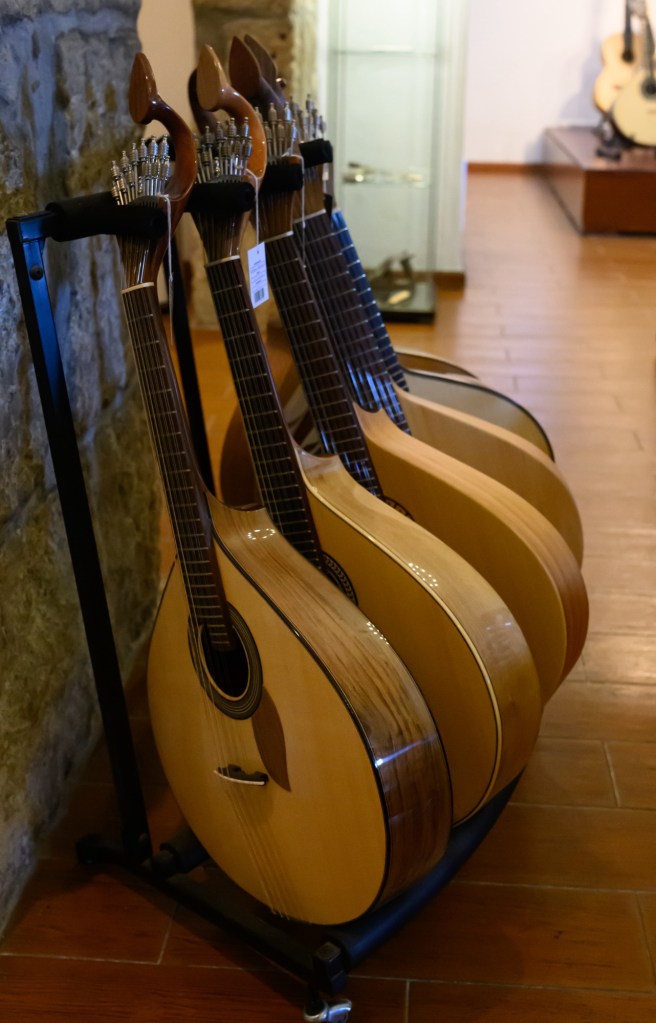
All of this results in an instrument which is relatively higher pitched and is able to cut through and be more easily heard.
Despite Sally’s encouragement, I decided to pass on buying an instrument. It is different enough from the guitars I have that the learning curve would be steep, and I know I would not be motivated to do so as I don’t know or listen to the music it is best suited for. I’ve owned other instruments in the past that I couldn’t or wouldn’t play, and I got rid of them. That’s not my style of collecting.

The last thing on our agenda was a last minute addition. Just down the street from the guitar store/museum was a steel bridge across the Douro River. This was the Luis I Bridge, a steel arch bridge. Originally built for vehicular traffic, the upper deck is now for pedestrians and trolly buses.
From there we headed back to the hotel by Uber. The ride was about 10 minutes over 1.7km; it turns out that walking would have only been about 0.8km. But it was uphill, and we were pretty tired. So it was $6 well spent.
After resting for a while we went out to a small restaurant in a nearby plaza. Again, dinner was simple, tasty and inexpensive. I think we’re getting the hang of this Portuguese food.
(1) The timing was fortuitous, as we were up for a couple of hours in the middle of the night to watch the Great Debate, which was at 2:00 am Western European Time.
(2) This entire incident was very unusual. We’ve found the taxis to be prompt – usually arriving in less than 5 minutes – and the drivers friendly and helpful. We told the hotel desk staff when we returned, and they in turn informed the taxi company.
(3) The ukulele was brought to Hawaii by Portuguese sailors at the end of the 19th century. The name is Hawaiian.
 The Bassman Blog
Pics didn’t come through! Left me hanging. 🙂
LikeLike
Try again, they look good to me.
LikeLike