Shortly after leaving for the drive this morning we came across a relatively unusual sight, African wild dogs. According to Wikipedia, there are only about 6,600 adults on the entire continent. So seeing this pack of three out hunting was a win for us.

They always hunt in packs, and are very effective hunters. The hunting group of 3-7 has both males and females. All of the breeding in the pack takes place with the dominant female, and she takes care of the pups. We saw this group for a minute, then they disappeared into the brush.

Next was a baboon, high up in a dead tree, enjoying the warm morning sun. Kruger mornings this time of year (winter!) are chilly, in the 40s Fahrenheit (1). Combine that with moving in an open car at 20 mph (2) and you need to dress warmly. Also sunning themselves in another tree was some kind of eagle.

We saw a couple of spotted hyena walking in the brush. They’re not especially rare, but we hadn’t seen any this trip.

We finally got a glimpse of hippos in their normal pose, mostly submerged in water. While it was nice to see them, we were hoping to get a more interesting view, and perhaps see more of their bodies. Which are quite large!
The next group we came across were our old friends, the elephants. There must be a few herds roaming around this area, as we see elephants quite often. In fact, we drove past two separate herds about 20 minutes apart. The elephants can move fast, and we’re driving slowly, but I don’t think we saw the same herd twice.
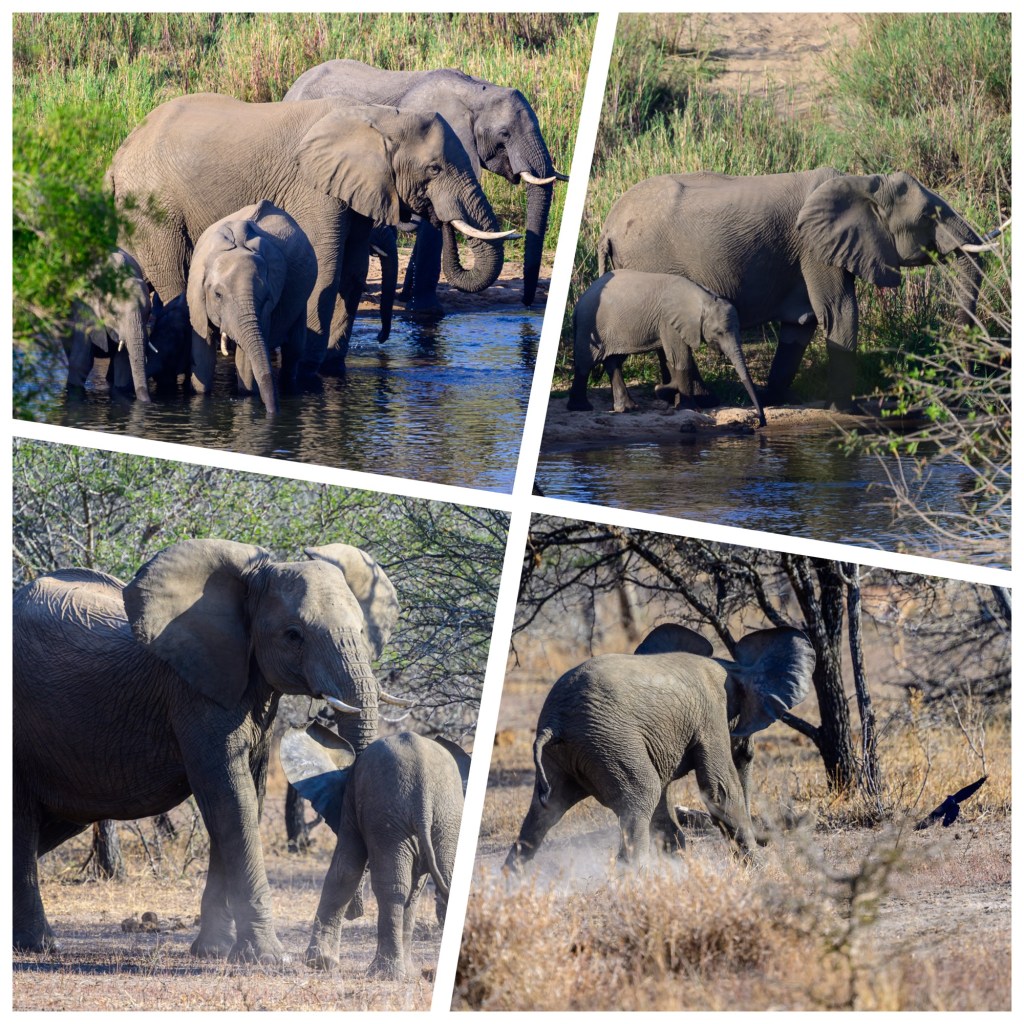
The top two photos are the first group, who were bathing and drinking in the river. The bottom two show Mom disciplining the baby for chasing a bird. Everyone knows elephants can’t catch birds!

We went back to the camp for breakfast, and then I did some writing and editing in our cabin before going back to the main lodge for lunch. Our luck in sightings without leaving home base continued, as a herd of giraffe were grazing right across the river from us. With sightings like this, we don’t need to go on game drives (just kidding; we will go on as many game drives as we can).
When we started the afternoon game drive, Hugh informed us that he might have a surprise for us later. I’m not sure I like this tease, but if it makes him happy, whatever. So we went on our merry way, driving along the dusty roads on our way to … somewhere. The reserve is about 12,000 acres, equivalent to 20 square miles – perhaps 4 miles by 5 miles in size. But none of the roads are straight, and we don’t have a map (I’m not sure they are available), so we could be – and to some extent were – driving in circles all day. But off we went.

Along the way we passed the usual suspects: a large herd of buffalo, more elephants, a few zebra.
After driving for a while, I started to recognize where we were. We went over the rickety bridge from yesterday, and started the slow creep through the woodlands with the vehicle tilting first one way, then another, at an alarming angle. Of course, as Sally likes to point out, neither Hugh nor Rix want to die, so we assumed that it was safe.

We pulled up to the hiding place where the leopard was dining on his kill last night, but it was empty. Hugh then took us on another vertiginous drive and we came to a tree. Not just any tree, but the tree where the leopard had dragged his prey after resting for a while. Leopards are the only large predators that are good tree climbers, so they will often hide their food in a tree. Vultures could get to the food, but that’s about it.
I have some more photos, but as they make it quite clear what the leopard is doing, some people may not want to view it. I think it’s not much different than barbecue ribs, just very rare. If you want to see a few closer shots, click the link:
https://thebassmanblog.com/wednesday-august-14-a-leopard-feeding-not-for-the-squeamish/

As we waited, the leopard finished eating and sat up in the tree. After looking around to make sure there were no threats in the area, he proceeded to walk down the tree, head first, and disappear off into the bush.

By this point, all that was left was to find a spot for a sundowner. The kids wanted more than just drinks and snacks, so they decided to climb an inviting tree.

It got dark soon after. But as we worked our way back home in the dark, who should appear in front of the car, but the leopard. Of course, I can’t be sure it was the same one, but it was pretty close to where we last saw it.
(1) It was warmer in Phinda, with the sunrise temps in the 50s F, and as warm as 60F one morning.
(2) The speed limit in the reserve is 30 kph or about 18 mph. I never saw the car go above 32 kph.
 The Bassman Blog