The two most important museums in NOLA are the NOMA, which we visited yesterday, and the National WWII Museum. I’m not a big fan of glorifying war, although I have the utmost respect for the people that make huge sacrifices so that I can enjoy the benefits of a free country. But the WWII museum in NOLA has a reputation for being excellent, and many people feel that a single day is not enough time to really cover it. Rob and Laura thought one day would be enough, while Sally and I though a little less than that would work. So they went early and got a headstart, and we arranged to get there around 11 and meet them when a movie they wanted to see ended at noon (1).

I’ll say right up front that everyone who visits NOLA should go to this museum. It’s one of the best museums I’ve ever been to, telling the gut-wrenching story of the war with its victories, losses, brilliant guesses and stupid decisions. Wars suck – all wars. People die and are maimed. Not just the fighters, but the civilians that get caught in the cross fire, or worse, are deliberately targeted by one of the combatants to achieve some political or racial goal.

A major part of the museum is the story of the two main theaters of WWII, the European and the Pacific theaters, told from the American perspective. They do a great job of providing context to some of the decisions that various countries made as the world moved towards the war. Some of this was stuff I knew, some was stuff I had forgotten, some was new to me. For instance, why did Japan attack Pearl Harbor? Probably in part because they had been fighting with China for ten years, and the US was supplying China with weapons and supplies.

Another point that the museum makes, repeatedly, is how the American and Allied generals made lots of mistakes and suffered many defeats as they struggled to defeat the German and Japanese forces. I don’t mean this to be critical; they were working with highly imperfect information and had to assess how to proceed without having all the facts. For instance, early in the war one could not know where an enemy’s warships were – there was no satellite technology, and even radar was very primitive. So the fleets and aircraft would go to where the strategists thought they might find the enemy, but were often wrong.
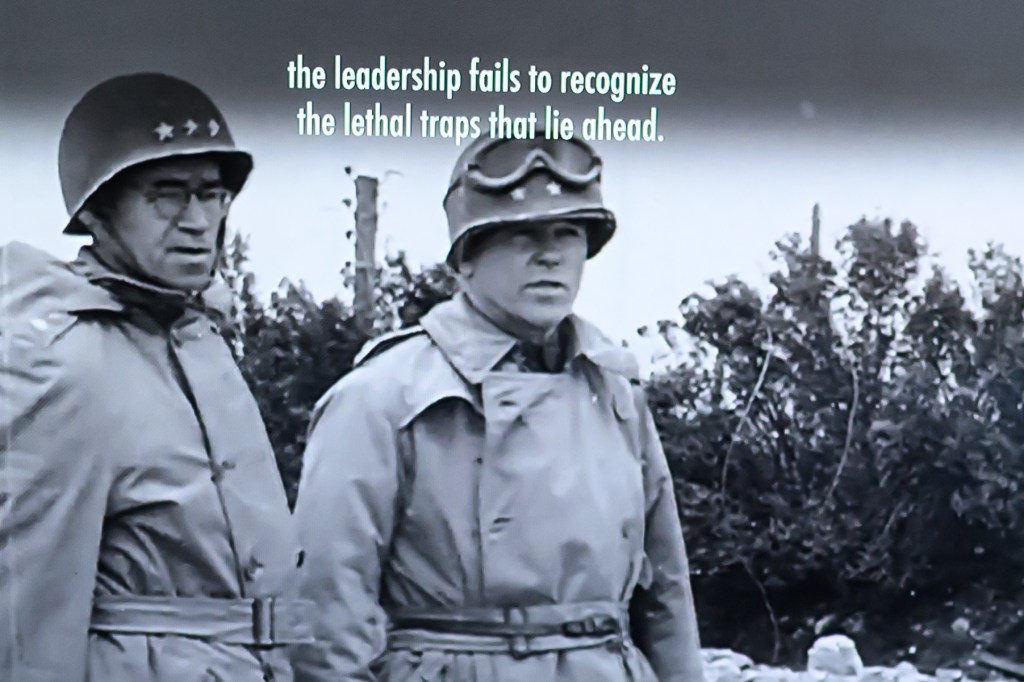
My sense is that we won what became a war of attrition – in both theaters – because our manufacturing capability was larger and it was almost never attacked or damaged by the enemy. In contrast, a key part of our strategy was to destroy the manufacturing capabilities of both Germany and Japan. This was ultimately successful and contributed significantly to the victory.
The museum includes lots of vignettes about the bravery and actions of individual soldiers, sailors and fliers who took enormous risks to protect their fellows and win individual battles. I’m sure, although it’s not mentioned at all, that the enemy had the same experience. They just didn’t have the resources to last long enough.

There’s an entire section of the museum devoted to the Holocaust. There’s a room about Anne Frank. There are continual film loops of the concentration camps, the US soldiers reactions when they discovered them, the prisoners reaction to the arrival of the Allied troops. They have oral history videos from the Shoah Foundation of survivors talking about their experience.
I walked out a bit overwhelmed by the complexity of managing the war, given the number of moving parts (3), imperfect information about what was happening, limited knowledge of what the enemy was planning, and the competitiveness amongst the Allied political and military leadership. It reminded me that ordinary men and women can do extraordinary things under pressure – extraordinarily good, and also extraordinarily horrible.
If you get down to New Orleans, make it part of your visit.
(1) We also had complementary tickets for the museum, but not the movies, that we wanted to take advantage of.
(2) Most of the images in this post are photos I took from short videos that are shown continuously throughout the museum.
(3) About 16 million men and women served in the military during the war. This was 12% of the US population at the time.
 The Bassman Blog