This trip – our second to Africa – will be with our daughter and her family, a husband and three girls. The seven of us agreed that we will travel without any checked baggage, which will be a first for Sally and me (1). The kids always travel check-in free; there are many reasons this is a great way to go, as you can imagine.
- No chance of your luggage getting lost.
- No pesky airline fees for checked bags.
- No time wasted waiting at the baggage carousel.
- You’re forced to pack less stuff, which makes (almost) everything simpler while traveling.
- Less time packing and unpacking at each stop.
- Simple to make last minute changes, such as changing your flight, as your stuff is always with you.
The two major disadvantages are:
- You have to drag all of your stuff around the airport with you, and watch it in the airport while you eat, etc. This is offset by the need to keep some stuff with you even if you check a bag; Sally always traveled with a small rolling case and a personal item in addition to her checked bag. I always have at least a backpack with camera gear and other valuables.
- You can’t bring stuff which is not allowable as carry-on: a pocket knife for me, personal care liquids above the 1 quart baggie for Sally.
Frankly, this trip will be a challenge to fit into the carry-on capacity we’re allowed. Sally has never traveled this way before, meaning it’s a radical re-think of what she will bring. And I have to include my safari photography kit, which is bigger than I brought to London. Yet I believe we will make it work.

The first key is to limit your clothing. The safari camps are strictly casual, which makes it easier. But the ones we’re staying at will also do laundry each day. So we need enough clothing for the three nights in Cape Town, and then we can simply rotate anything that needs laundering each day, except the last day at each stop.
Here’s my clothing list:
- One pair of jeans and one pair of hiking pants
- Three long sleeved shirts
- Four sets of underwear, merino wool t-shirts, wool socks
- A light merino wool long-sleeved t-shirt
- A thin puffy Patagonia jacket – it’s winter there, and it’s cold at 6:00am when we leave for the morning game drives.Update: we both brought lightweight down jackets. Sally added a heavy down coat in Cape Town, which worked well for her.
- A windbreaker/rain jacket shell
- Photography vest – large pockets, great for stuffing cameras and lenses into if the gate attendants insist you check your camera bag
- Sturdy shoes – lightweight hikers or the like
- An extra pair of casual shoes in case the main shoes get wet or ruined
- Probably a woolen hat and light gloves – it’s winter, etc.
- Tilley Airflo hat (this hat has literally been around the world with me since 2009)
Aside from that, Sally has a variety of things which I won’t get into here. But I also have other stuff. While none of this stuff is big, it adds up to real space in the bag.
- Most important are my meds. Unfortunately, at my age the formulary keeps getting longer.
- Sunglasses, extra eyeglasses.
- iPad, iPhone, Kindle.
- Passports, cash (2), credit cards (3).
- Tech kit – power supplies, plug adaptors for South Africa, cables, battery pack, etc.
- Noise cancelling earbuds for the flights.
- A Patagonia sling bag to use for sightseeing, and to carry some stuff I might need on the game drives.
Finally, there’s the camera kit. Being that this is primarily about the safari, I’ll be bringing a pair of lenses to cover our likely distances from the animals. And as always, two cameras to mount them on (4). Then there are all the accessories, such as batteries, memory cards, chargers, cleaning supplies, etc. I also wear a photography vest, which has large pockets that I can use to hold the cameras if I’m forced to check my backpack.
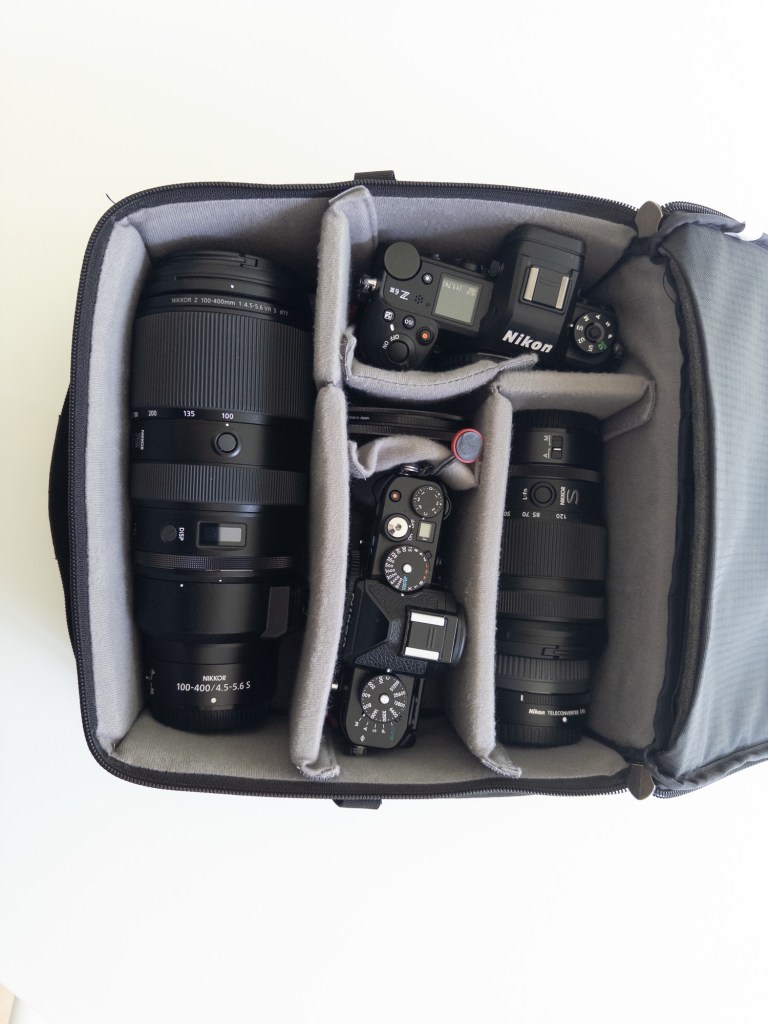
To hold all of this stuff, we each have a 21.5″ carryon roller bag and a 20 liter backpack. Sally’s backpack is adorable and will easily fit under her seat. Mine is big and utilitarian, as I need to accomodate the camera gear. It most likely will have to go in the overhead, which I’m assuming won’t be a problem. If I get hassled getting on the plane, the cameras and lenses are in an inner bag which I can remove and carry separately. The rest of the backpack can then be gatechecked if necessary.
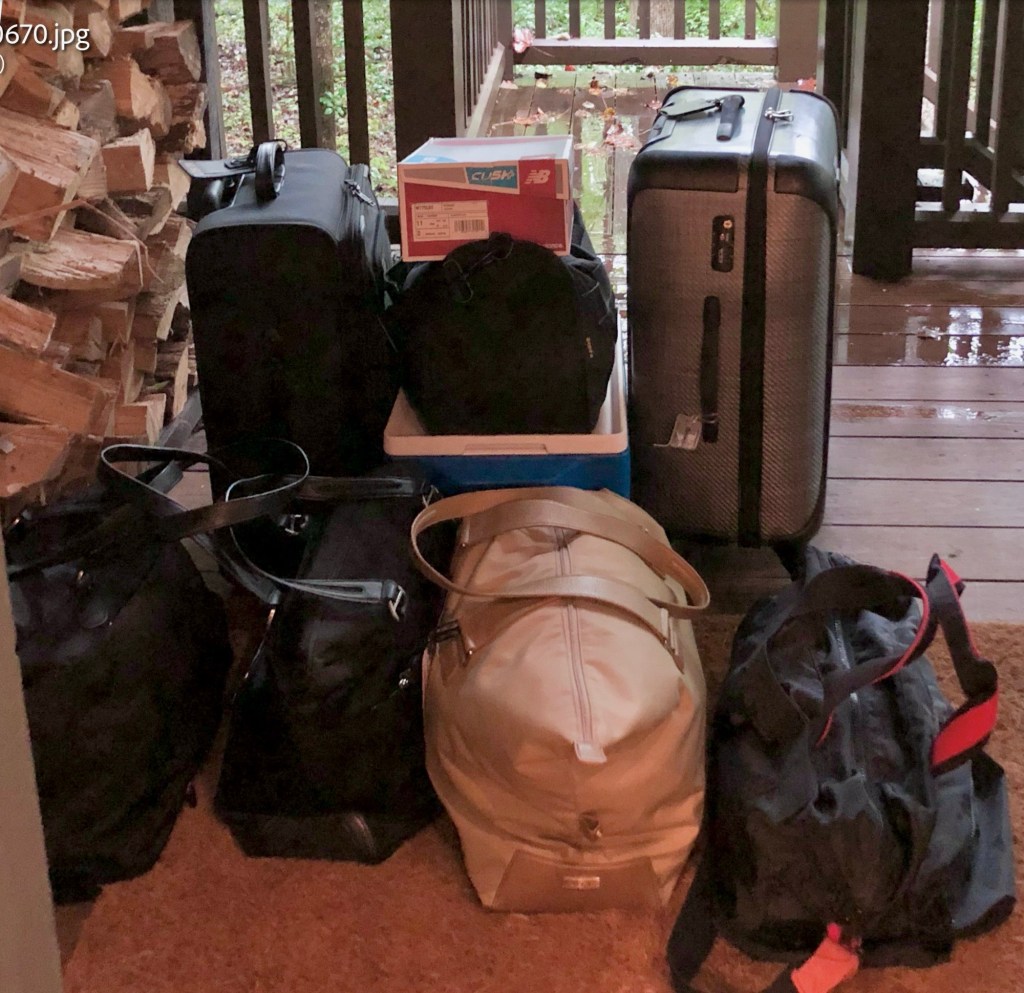
Just to show how far we’ve come, here’s our load-out for a two week (car) trip we took in 2018.
A few notes about how well all this stuff worked
The clothing was pretty spot-on. I used both pair of pants as expected. I never unpacked my “extra” shoes, wearing the Oboz hiking shoes every day. I wore the long-sleeved merino wool t-shirt most days on the game drives, and could have used a second one to alternate with rather than the third button down shirt – two of those would have sufficed. The underwear worked well, and both of my jackets got use. I used the gloves a few times in the early mornings, but never wore the woolen cap, preferring my Tilley Airflo every day.
The core camera kit was perfect. In Cape Town, I used the tiny 40mm lens for walking around, but prefered the 24-120/4 for our sightseeing day. In the camps, the 100-400/4.5-5.6 got 70% of all the usage, with the 24-120 with 28% and 2% for my iPhone.
I over-equipped myself with accessories:
- I brought seven batteries in total, but never used more than three any day.
- Four total batteries would have been perfect.
- I brought five extra pairs of memory cards (each camera uses two at a time), but never changed the two in my camera.
- Two extra pairs – one for each camera – would have been enough, but the carrying case for these would then be partially empty and I wouldn’t have saved any space.
- I brought a table-top tripod with never got used.
- I keep bringing this with me and never use it – I need to learn.
- I brought a complete camera and lens cleaning kit, but only used a couple of pieces.
- Probably good to have anyway – dust can kill your images.
- I brought two card readers, but only used one.
- One would have been enought, as the cameras can plug directly into my iPad. But the second one is tiny and lives in my tech kit.
- I brought two battery chargers, but only used one (each one can charge two batteries at once).
- One would have been more than enough; you can charge the battery directly in each camera anyway.
- I never needed the photography vest, and in fact, I packed it in the Tumi for the trip home.
- I’ve never been prevented from bringing my camera bag onboard, so maybe it’s time to drop this paranoia.
I brought my somewhat overstuffed tech kit, which carries all of the power supplies, a backup battery pack, USB cables, etc. While I probably didn’t need every single component, it takes a fixed amount of space in my bag and it seems you always need a different configuration of power supplies, adaptors and cables at every stop, on the long-hall flights, and in the airports. So I was pretty satisfied with this.
Finally, the bags – my Tumi carry-on and the Think Tank Speedtop backpack – performed admirably, carrying more stuff than I expected they could without a single complaint. The Patagonia sling bag, which was a last minute addition and was packed in the suitcase, got use almost every day we weren’t flying.
(1) I always traveled with carry-on only when I was traveling for business. I also went carry-on only for my recent photography sojourn to London; that was the first time I did so with lots of camera gear. Sally has never experienced the freedom from the tyranny of the luggage carousel.
(2) We have to tip everybody we see, expecially at the camps. Fortunately this is all done with US dollars. It’s more cash than I’ve carried on a trip since, well, the last time we went to Africa. Update: the bulk of the tips occur in the camps, and they all allow you to add the tips for the ranger/guide, tracker, waiter and general stuff to your bill and therefore charge it.
(3) Sally and I learned the need to have different credit cards with each of us from our Morocco trip.
(4) I always take a second camera on a photography-oriented trip – there’s no way to replace something if it breaks while you’re in Africa. You also won’t have the time to change from your wide lens to the telephoto when you see the cheetah off in the distance. And it’s a really bad idea to be changing lenses while you’re driving around on dirt roads in an open car – it’s a sure way to get dust inside your camera and ruin your pictures.
 The Bassman Blog